

A tech job search service can filter roles posted directly by employers according to your job title, compensation range, location, and tech stack, then show onsite, hybrid, or remote openings that match your preferences. You choose which roles interest you and whether to apply. The service can also help tailor your resume and draft answers for each application. This article explains how listings are sourced and filtered, how work arrangements affect a match, and how to keep up with new opportunities.
Key Takeaways
- Separate onsite, hybrid, and remote preferences so location and work setup both shape your matches.
- Focus on employer-posted technology roles that fit your target title, pay range, location, and tech stack.
- Use job alerts to keep new matching openings in view without starting each search from scratch.
- Review role fit and use application preparation to tailor your materials, while keeping the decision to apply in your hands.
Onsite, hybrid, and remote work arrangements
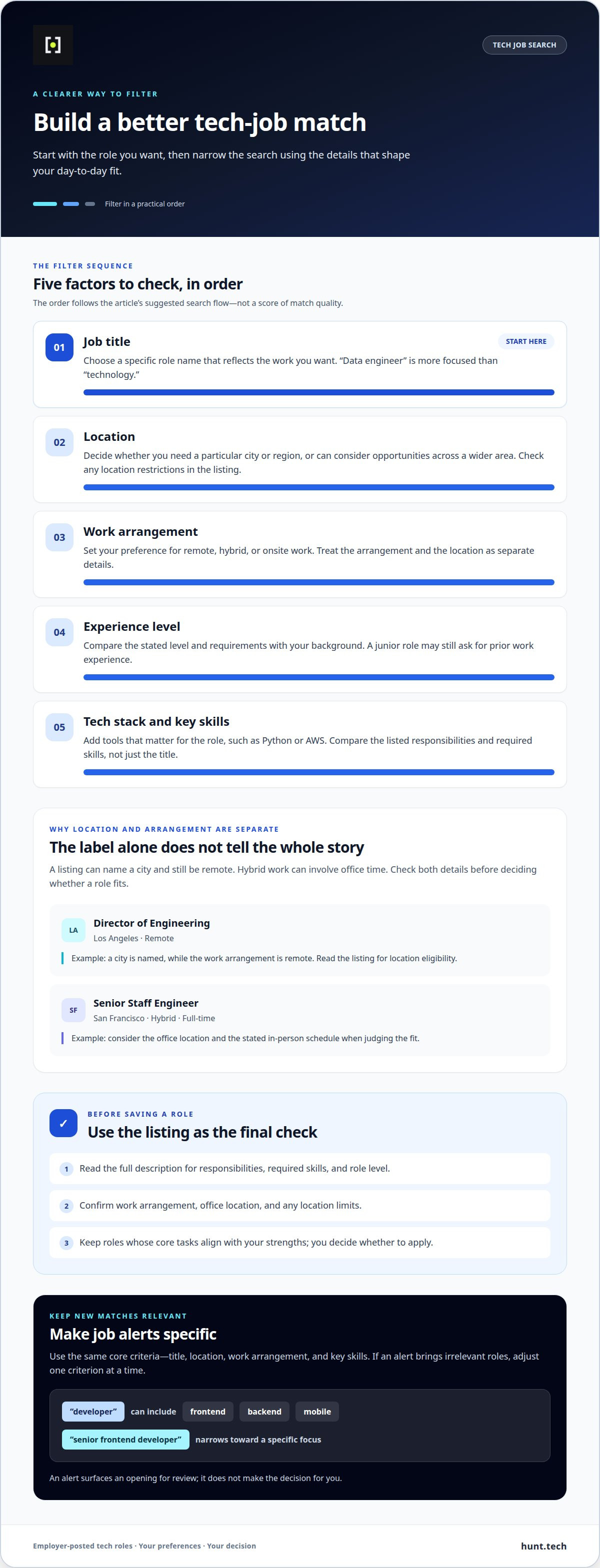
A role’s work arrangement affects where you need to live and how you work. For example, a Director of Engineering role in Los Angeles is listed as remote, while a Senior Staff Engineer role in San Francisco is hybrid.
Entry-Level Remote Opportunities
For entry-level remote tech jobs, look beyond the word “remote.” Check the required experience, role level, and any location restrictions in the listing. A junior software developer role may still require prior work experience, while an associate support engineer role may focus on core skills. Compare the requirements with your background before deciding whether the role fits. Also check whether the employer specifies a state or region where you must be based.
Remote and Hybrid Roles
Remote and hybrid tech jobs come with different expectations about where you work. A remote listing may still limit eligible locations, while a hybrid role can require time at a company office. The San Francisco Senior Staff Engineer example is marked hybrid and full-time. Before saving a role, check its work arrangement, office location, and stated schedule. These details help you judge whether it fits your day-to-day needs.
Remote technology jobs can appear under titles such as software engineer, data engineer, or cybersecurity analyst. The title alone does not tell you whether the role is remote across the United States. Read the location and eligibility details. A Director of Engineering role based in Los Angeles and marked remote is one example of a listing that pairs a city with remote work. Treat location and work arrangement as separate details, not interchangeable labels.
To compare remote jobs by city, group listings by the location named in each post and note the work arrangement. Los Angeles and San Francisco illustrate the difference: one example is remote, the other hybrid. For onsite roles, consider whether the office location makes the commute practical. For hybrid roles, weigh both the office location and the required in-person schedule. This keeps location preferences distinct from job title and seniority.
The San Francisco, California, Senior Staff Engineer is hybrid and full-time, with an annual salary range of 175k - 220k. A Seattle, Washington, Staff Full Stack Engineer position is remote and full-time, with an annual salary range of 150k - 200k.
Technology job listings
Technology listings cover roles across software, data, security, and IT. Organizations posted 28,865 back-end developer openings nationwide over the previous 12 months.
Job Search Filters
Filters narrow a broad set of listings to roles that fit your criteria. Start with job title, then refine by location, work arrangement, and experience level. Add a tech stack when specific tools matter, such as Python or AWS. Compensation filters can focus your results, but consider them alongside the role’s scope. A senior title may involve different responsibilities from a similarly named individual-contributor role.
Filters work best when each one reflects a genuine requirement. If you need remote work, exclude onsite roles rather than sorting them manually. If you’re open to nearby office locations, include those cities instead of limiting results to one ZIP code. For a back-end role, compare the listed responsibilities and tech stack, not just the title.
Employers and Openings
Employer-posted listings describe roles in the company’s own terms. NBCUniversal, for example, lists both a senior software engineer role and a senior cybersecurity event analyst role. The titles point to different kinds of work, even though both are in technology. Read each description for team responsibilities, required skills, and expected ownership.
One employer may post openings in engineering, security, and data. Assess each listing as a distinct role, not as a general invitation to join the company. Compare the required skills with your experience, then check the location and work arrangement. This helps you identify a plausible match rather than relying on a familiar employer name.
For each listing, check the posting date, requirements, and application link. A clear title can still hide a mismatch in seniority or day-to-day responsibilities. For example, a software engineering role may focus on platform maintenance, product features, or infrastructure. That changes which experience matters. Save roles whose core tasks align with your strengths, then read the full description before deciding whether to apply.
Colorado examples: Cox Enterprises’ Customer Care Specialist II at 18-27 hourly, Rula’s Manager, Partner Success at 118K-137K annually, and Cloudflare’s Senior Commercial Account Executive (Los Angeles) at 234K-321K annually.
Email alerts for new jobs
Email alerts can bring newly matched tech openings to your inbox. They work best when your search terms reflect what you want, such as “data engineer” instead of the broad term “technology.” A focused alert makes relevant listings easier to spot. Treat each alert as a prompt to review a role, not a decision to apply.
Set your core criteria first: title, location, work arrangement, and key skills. For example, an alert for a Python-focused backend engineer will differ from one for a cybersecurity analyst. Add terms that describe the work you want, then remove those that bring in unrelated roles. If “engineer” returns too many mismatches, use a more specific title to narrow the results.
Use location terms carefully. “Remote” may appear alongside a city or state, while “hybrid” can indicate a schedule that includes time at an office. An alert for remote software roles in the United States may return different listings from one tied to a city such as Boston. Keep the location broad if you can work across states, and narrow it when a specific region matters.
Inbox volume also depends on how narrowly you set an alert. A broad search for “developer” may include frontend, backend, and mobile roles. A more specific phrase such as “senior frontend developer” can exclude openings outside that focus. If an alert brings irrelevant results, adjust one criterion at a time. Changing the title, location, and skills together makes it harder to tell what improved the match.
When an alert arrives, open the employer’s listing and read the full description. Check the title, required skills, work arrangement, and application details. A remote label, for example, does not replace checking for location restrictions. Save roles that fit and pass on those that miss a firm requirement. Alerts surface openings; you control what happens next.
Searching and filtering tech jobs
A focused search starts with criteria that distinguish strong matches from near misses. Set your preferred role title, location, compensation range, and tech stack. For example, “backend engineer” and “Python” describe a narrower target than “software.” Separate must-haves from preferences so one flexible detail doesn’t rule out a role that otherwise fits.
Filters work together. A remote role in your field may still fall outside your location or compensation range. A job with the right title may call for a different tech stack. Compare each listing with your full set of criteria, then read its fit explanation. That makes the reasons for a match clearer than the title alone.
- Title: Search for a role such as data engineer or security analyst.
- Location: Set a city, state, or remote preference that suits you.
- Compensation: Use the range you have in mind to narrow results.
- Tech stack: Include tools that matter to your day-to-day work.
Review which roles remain after applying your filters. If a search for “backend engineer” returns roles focused on another specialty, adjust the title or tech stack. If a location setting removes too many suitable openings, broaden it while keeping essential skills in place. Changing one preference at a time shows which setting is shaping the results.
Even a strong match deserves a closer look. Compare the listing’s responsibilities with your experience, and see how the fit explanation connects your preferences to the role. A familiar title does not guarantee that the work suits your goals. Use the listing details to decide whether to shortlist it, rather than treating every result as a prompt to apply.
Explore job matching to see how role criteria can shape a more focused search.
Hunt
Hunt helps you find technology roles that match your preferences and keep track of openings. Its listings come directly from employers’ official career pages. Set preferences for title, compensation, location, and tech stack, then review qualified matches and their fit explanations.
Use Hunt for job discovery and tracking when you want relevant openings gathered in one place. For a role you choose, application preparation can include a tailored resume and drafted answers. Hunt connects you to the employer’s application page; you decide whether to apply and submit the application yourself.
If you want support finding and preparing for suitable roles, contact Hunt to discuss your job search.
Set your next step
Your priorities may change as your tech job search unfolds. Decide what matters most now, such as a new specialty or more room to grow. That gives your next choices direction while leaving room to adjust.
Hunt helps connect your role preferences with job discovery and application preparation. You stay in control of which roles to explore and whether to apply. Use the support that fits your plans, then revise your focus as those plans change.
Contact Hunt about your job search to discuss what you’re looking for. Your next step can be a clear one.
Frequently Asked Questions
What if a job-search service could use AI to find your next job?
Hunt AI helps sort openings against your stated preferences, while you choose what to pursue. It matches roles to criteria such as title, location, compensation, and tech stack. For example, set a focus on backend roles using Python, then review the matches and their fit explanations. You decide whether a role merits an application.
How can a job-search provider help tailor your tech resume and LinkedIn profile for applicant tracking systems?
Hunt can tailor your resume to a specific role and help draft application answers. For your LinkedIn profile, keep job titles, skills, and work history consistent with your resume. Use terms from the posting only when they accurately describe your experience. For example, if a role asks for Python and you’ve used it professionally, name that skill clearly instead of repeating unrelated keywords.
What are the best websites and apps for finding tech jobs in the US?
Hunt gathers technology listings directly from employers’ official career pages and lets you filter by title, compensation, location, and tech stack. Email alerts can also surface new openings that match your criteria.
Which tech roles are in highest demand in 2026?
The article identifies back-end developer roles as a substantial source of openings, with 28,865 posted nationwide over the previous 12 months. AI/ML postings on Dice more than doubled in the past year, but it does not establish which roles are in highest demand in 2026.